NEURALLY
Neurally helps businesses engage customers with intelligent, human-like chat that works across web, apps, and beyond.
Branding
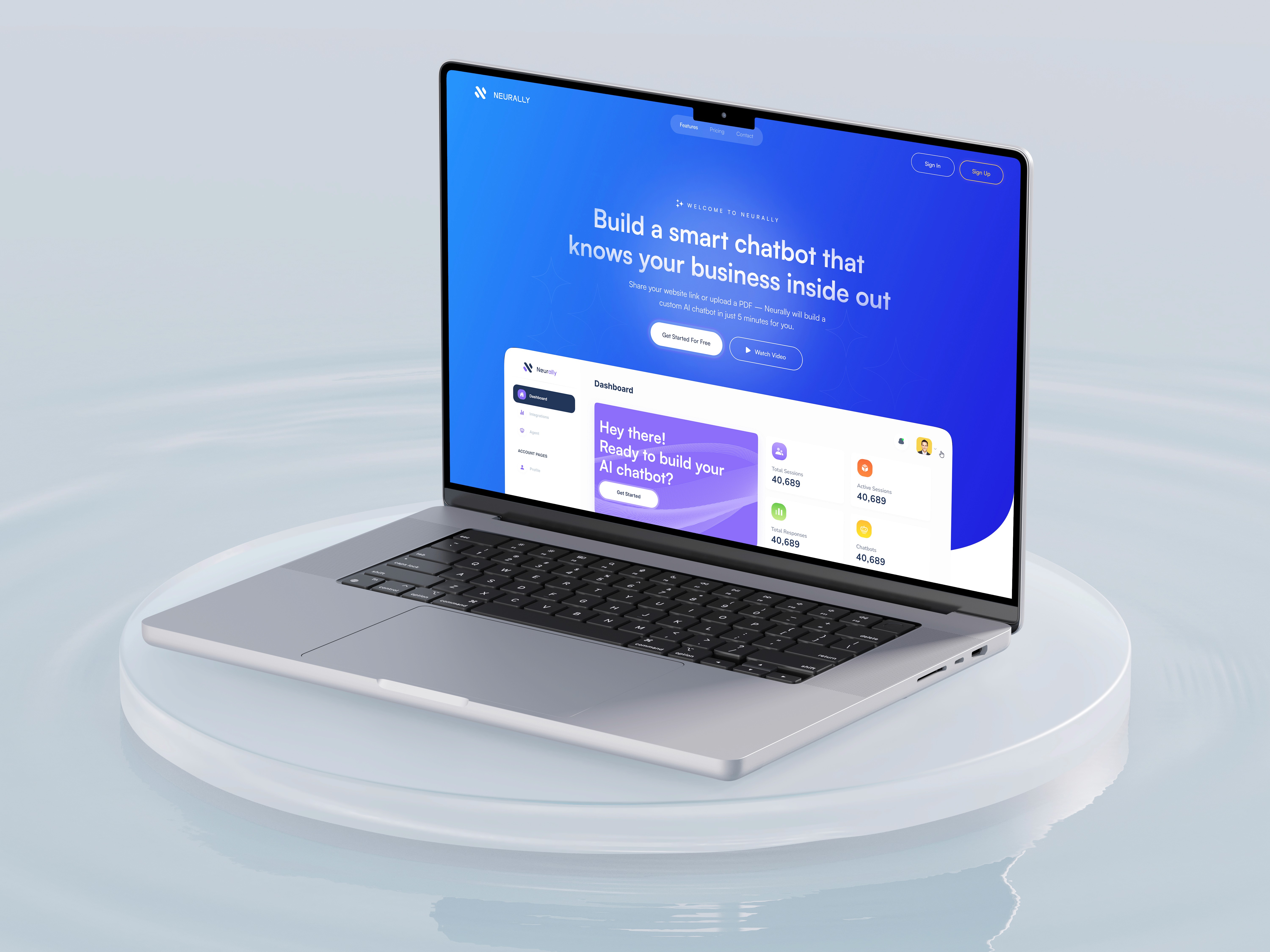
Website
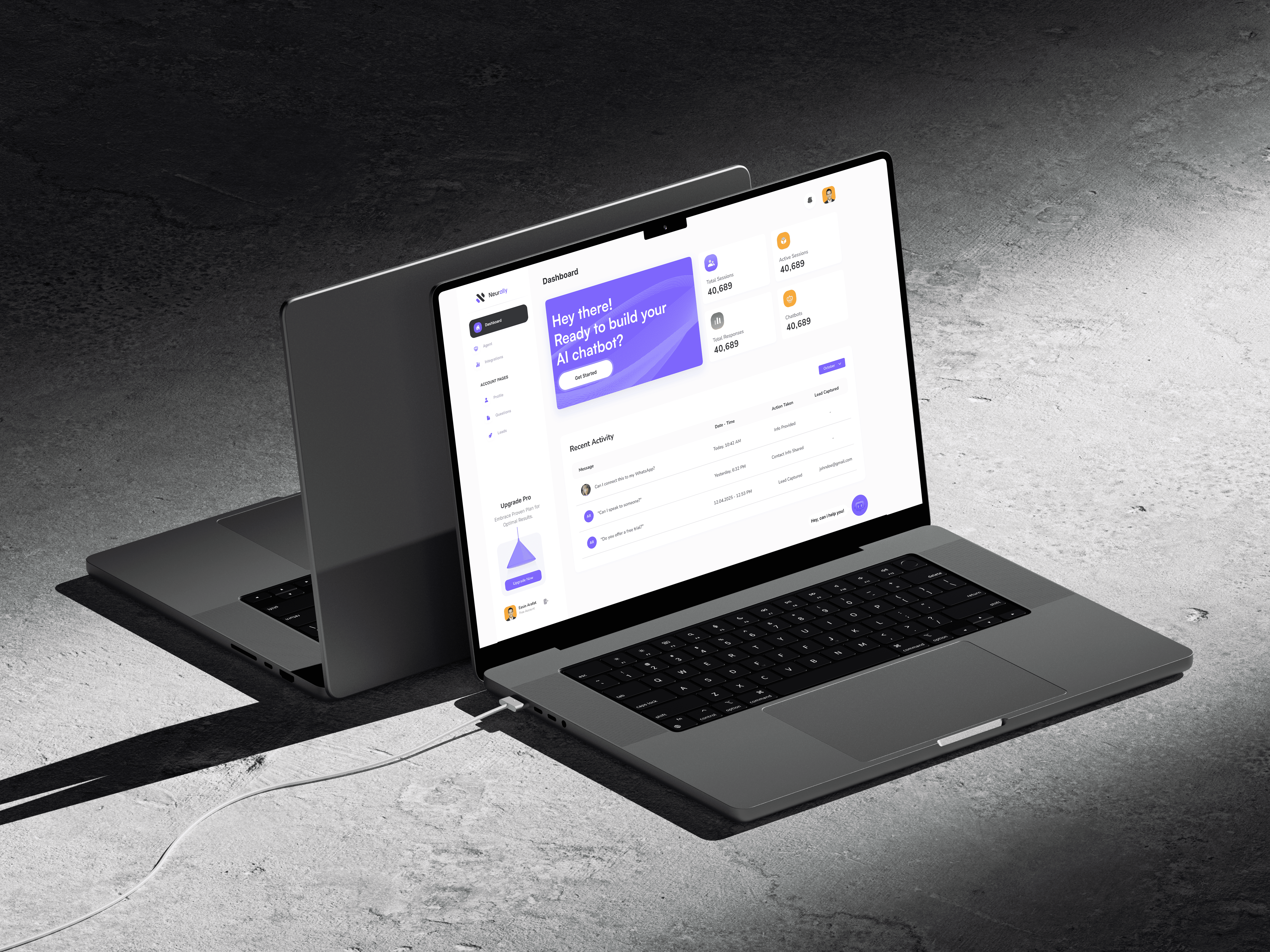
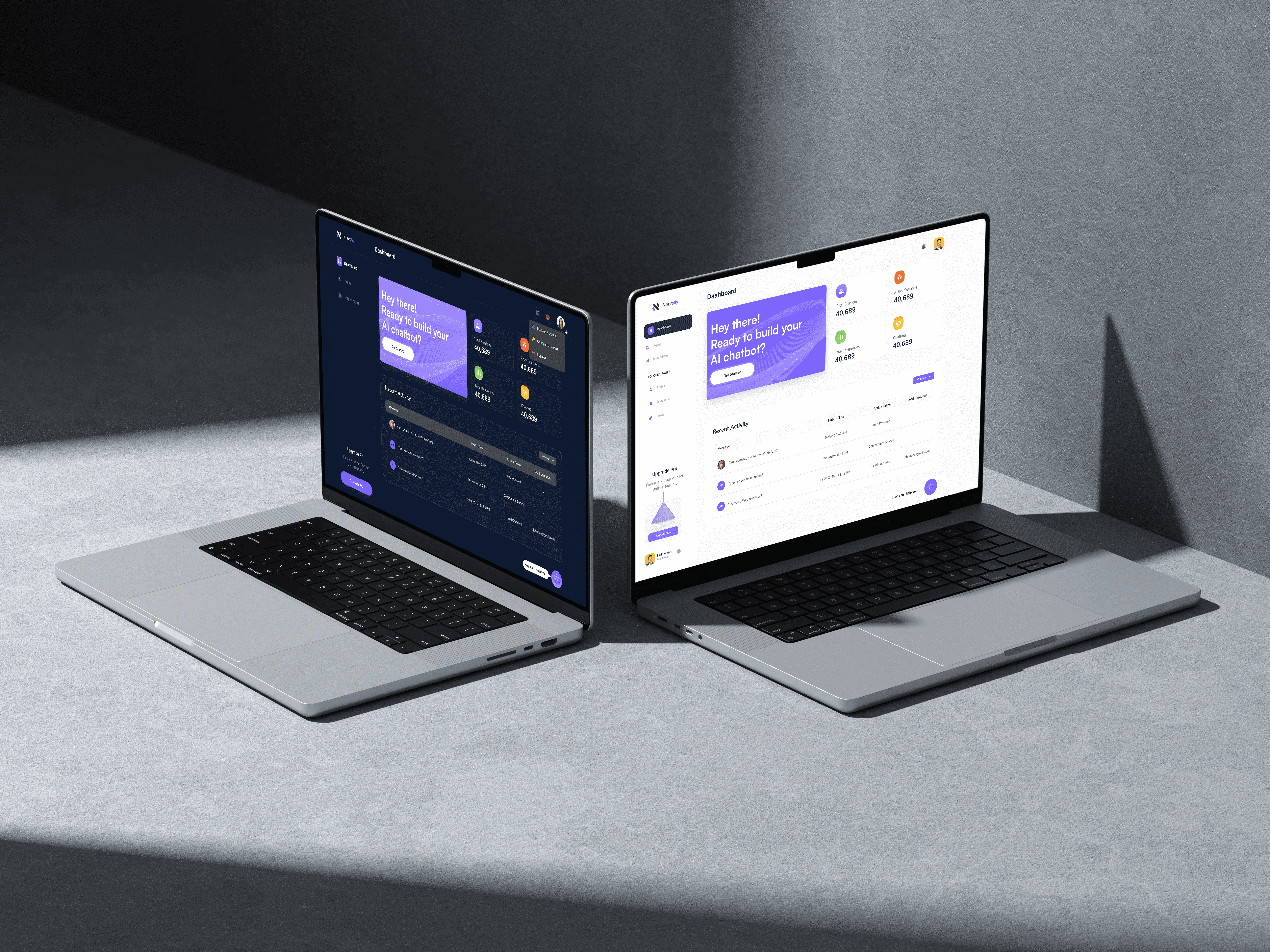
Dashboard
Introduction
Neurally is an AI chatbot platform that converts a company’s existing knowledge-website content, documents, FAQs, and internal databases-into a conversational assistant within minutes and without code.
Neurally - AI That Understands You like you.
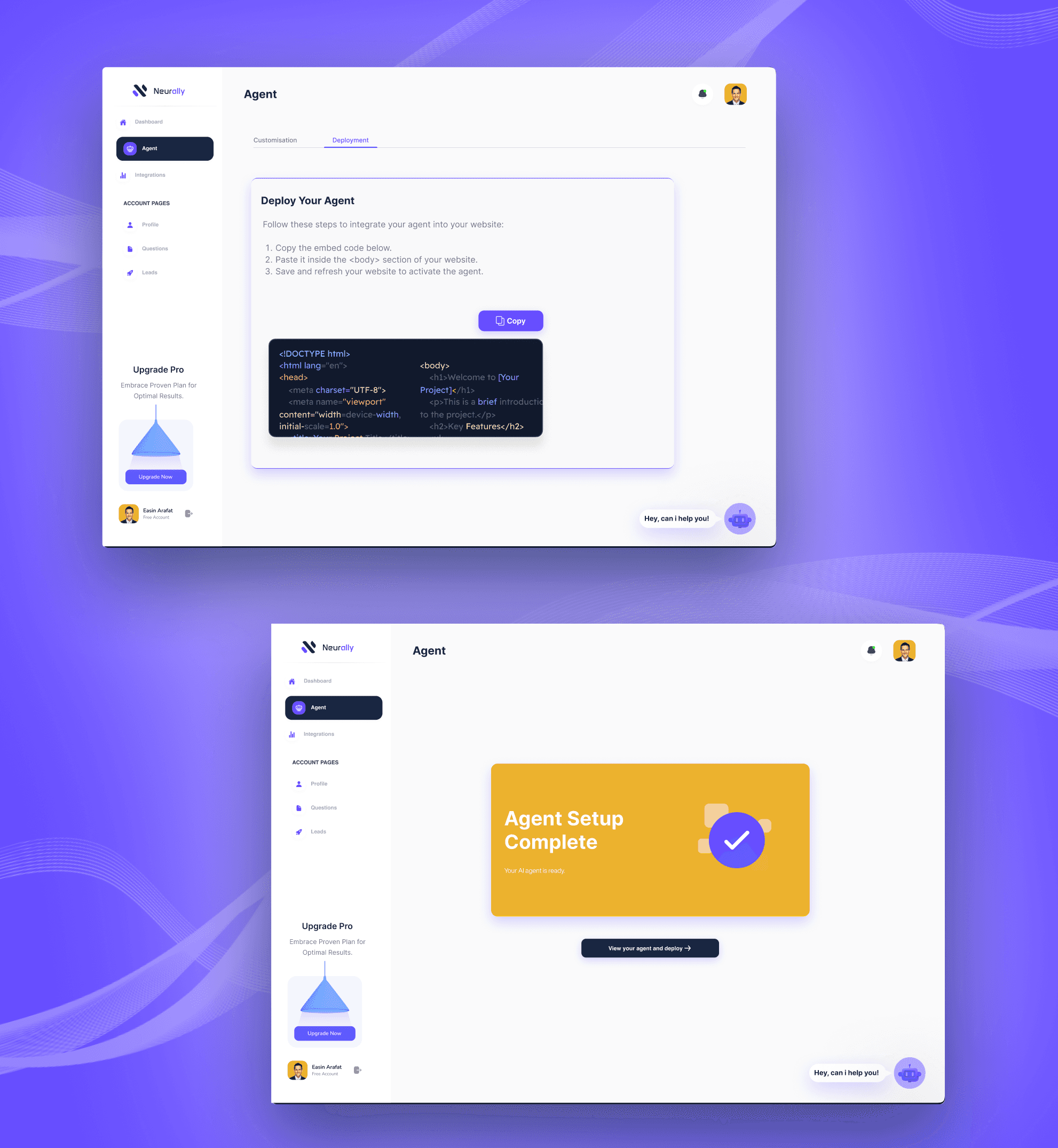
Teams embed it with one line of code or share a hosted link, then monitor performance and leads from a dashboard. Security and privacy are emphasized with enterprise-grade controls, while the bot answers using LLM-powered NLP, semantic search, and context awareness.
I led brand identity + logo, the marketing website, and the web app (dashboard + chat experience)—keeping the product’s AI core front and center while making it approachable.
Challange
Building a chatbot sounds simple in theory but in reality, it’s one of the most technically complex and resource-heavy processes a business can take on.
Building chatbots is notoriously complex. Most existing solutions demand a steep learning curve - requiring technical setups, flow-based scripting, and constant manual training. For small businesses, startups, or even mid-sized teams, this becomes overwhelming. The gap was clear: while AI itself is becoming more accessible, the process of creating and deploying an AI chatbot is still intimidatingly technical.
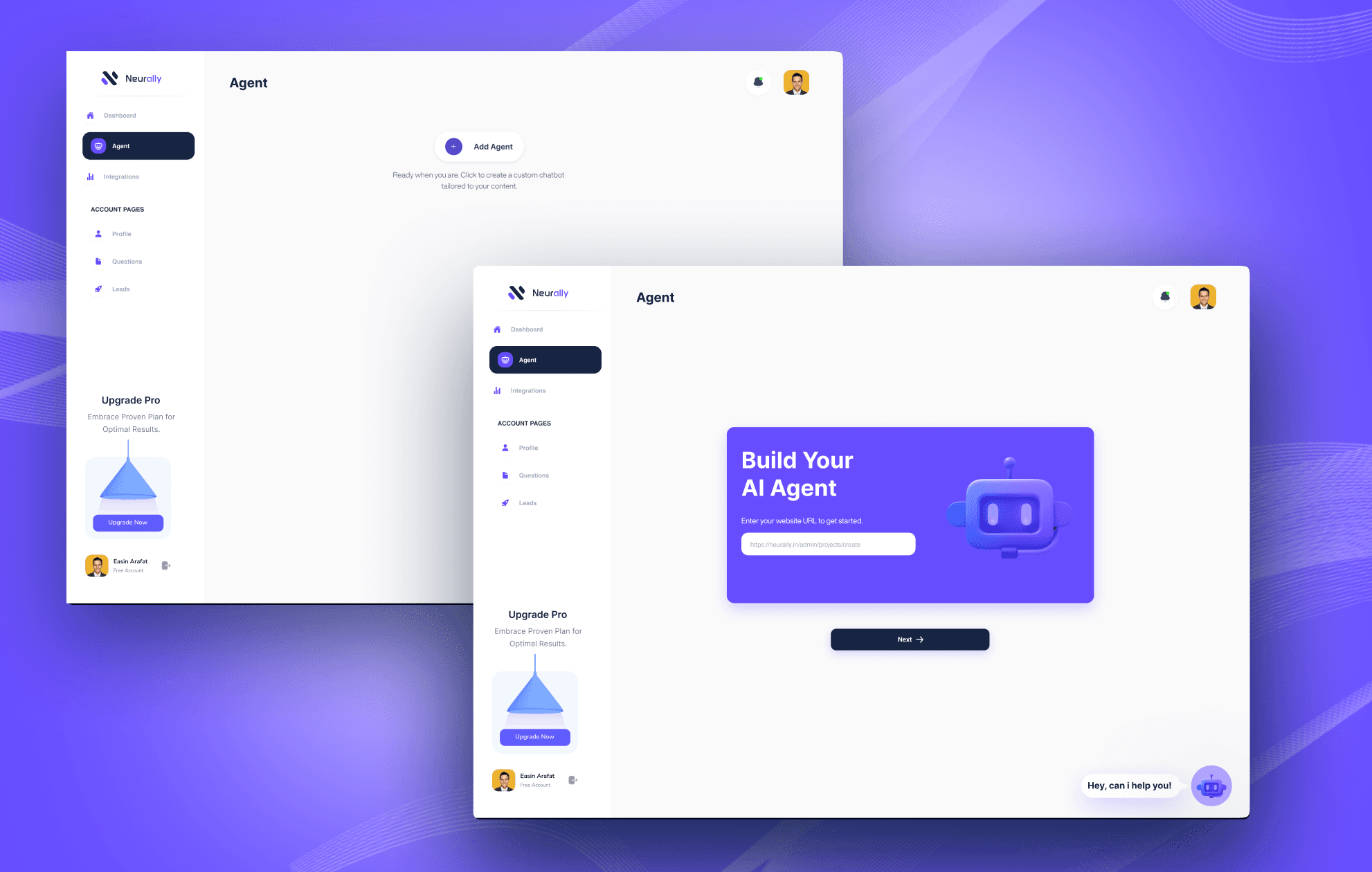
With Neurally, the vision was simple yet ambitious - let anyone build a powerful AI chatbot by just adding a website link, uploading documents, or feeding in basic content. But making “simple” work at scale is never easy.
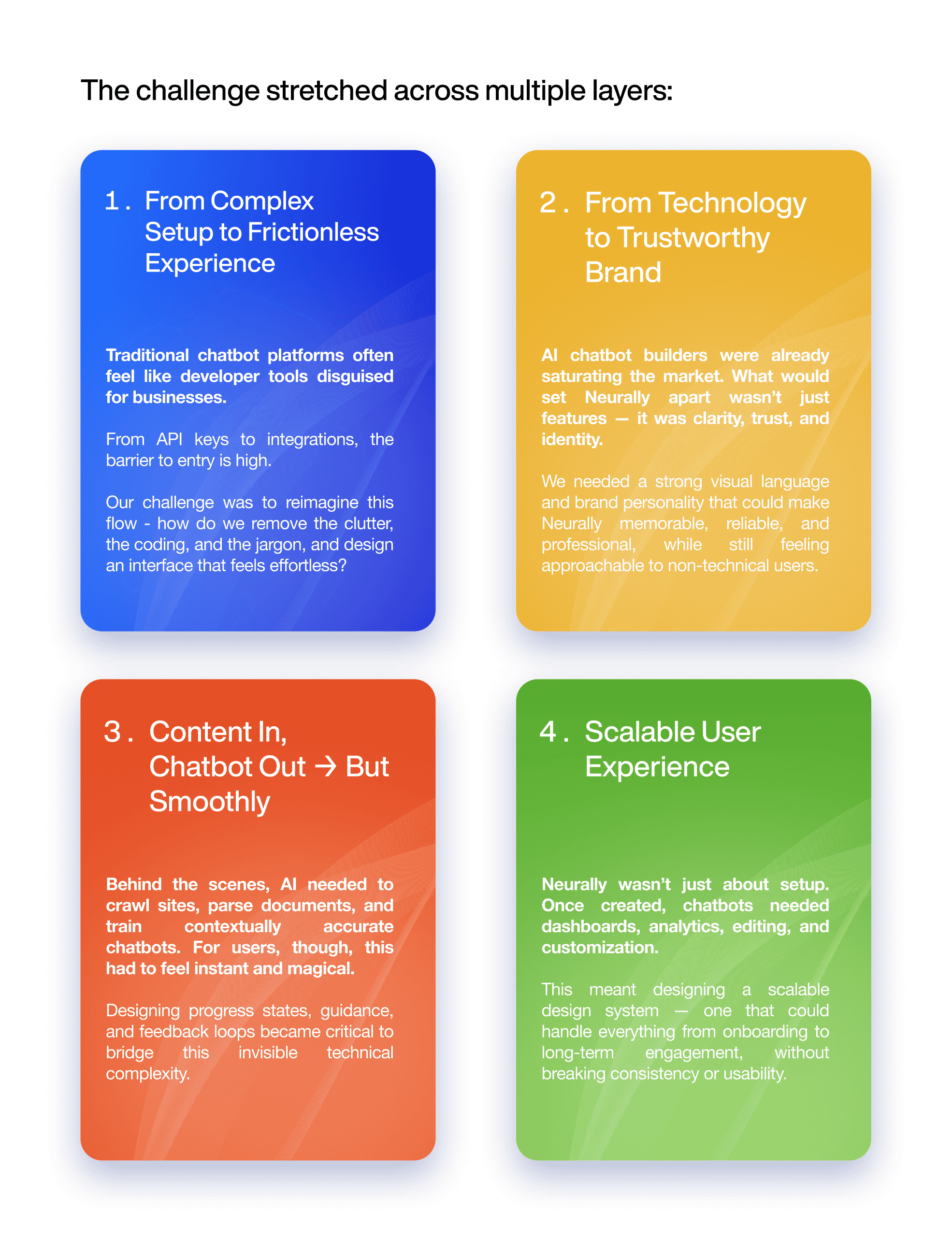
In short, the challenge was not just about designing a tool - it was about turning a technically dense process into a delightful, no-code product that anyone could use, while giving Neurally a brand identity strong enough to stand out in a crowded market.
Solution & My Role
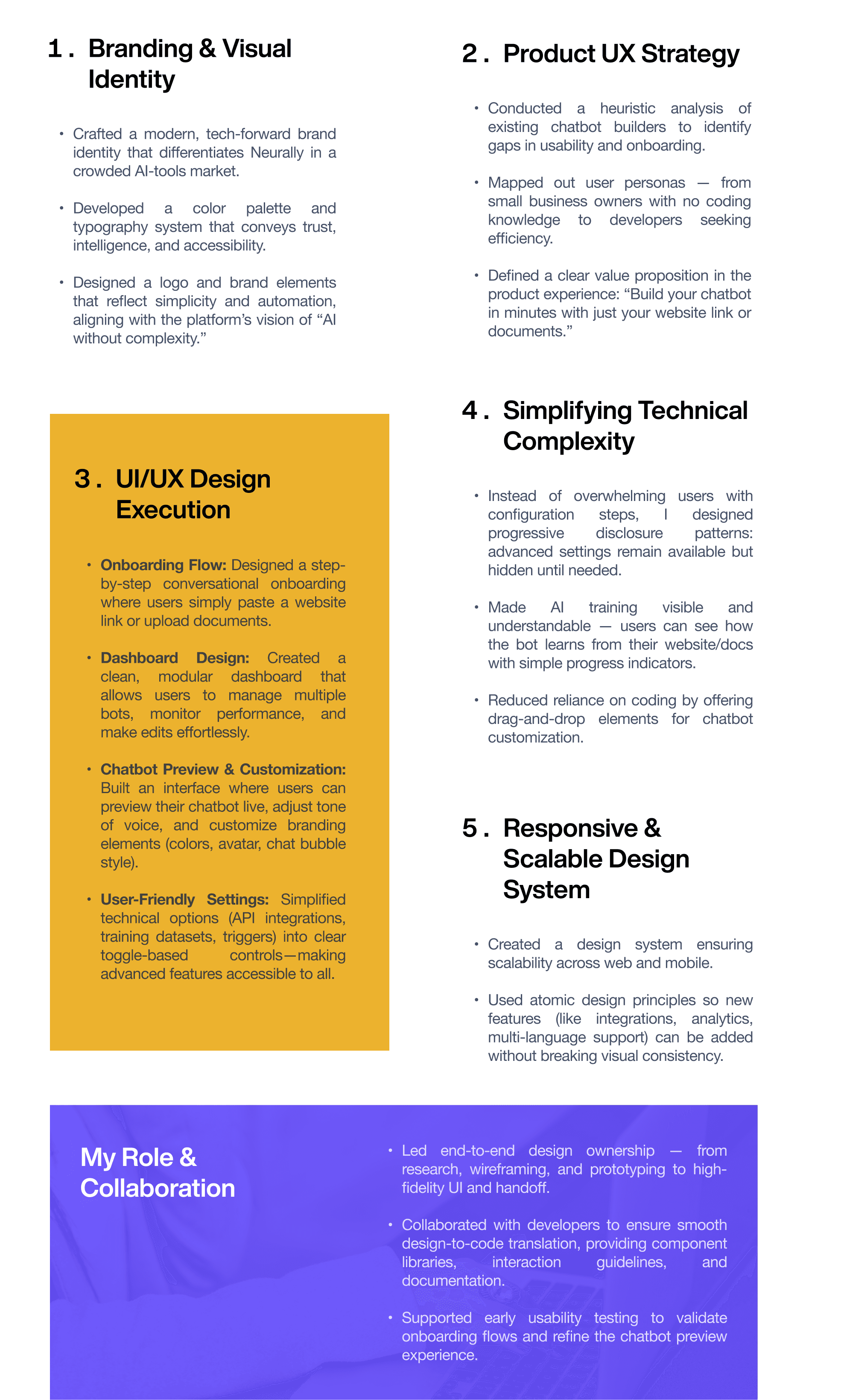
To tackle the challenges Neurally faced, I approached the project with a design-first mindset, focusing on creating a strong brand identity, intuitive user flows, and an engaging experience that simplifies chatbot creation for non-technical users.
Branding & Identity
When I began crafting the identity for Neurally, I knew the brand needed to feel human yet intelligent — something that resonates with both technology and empathy.
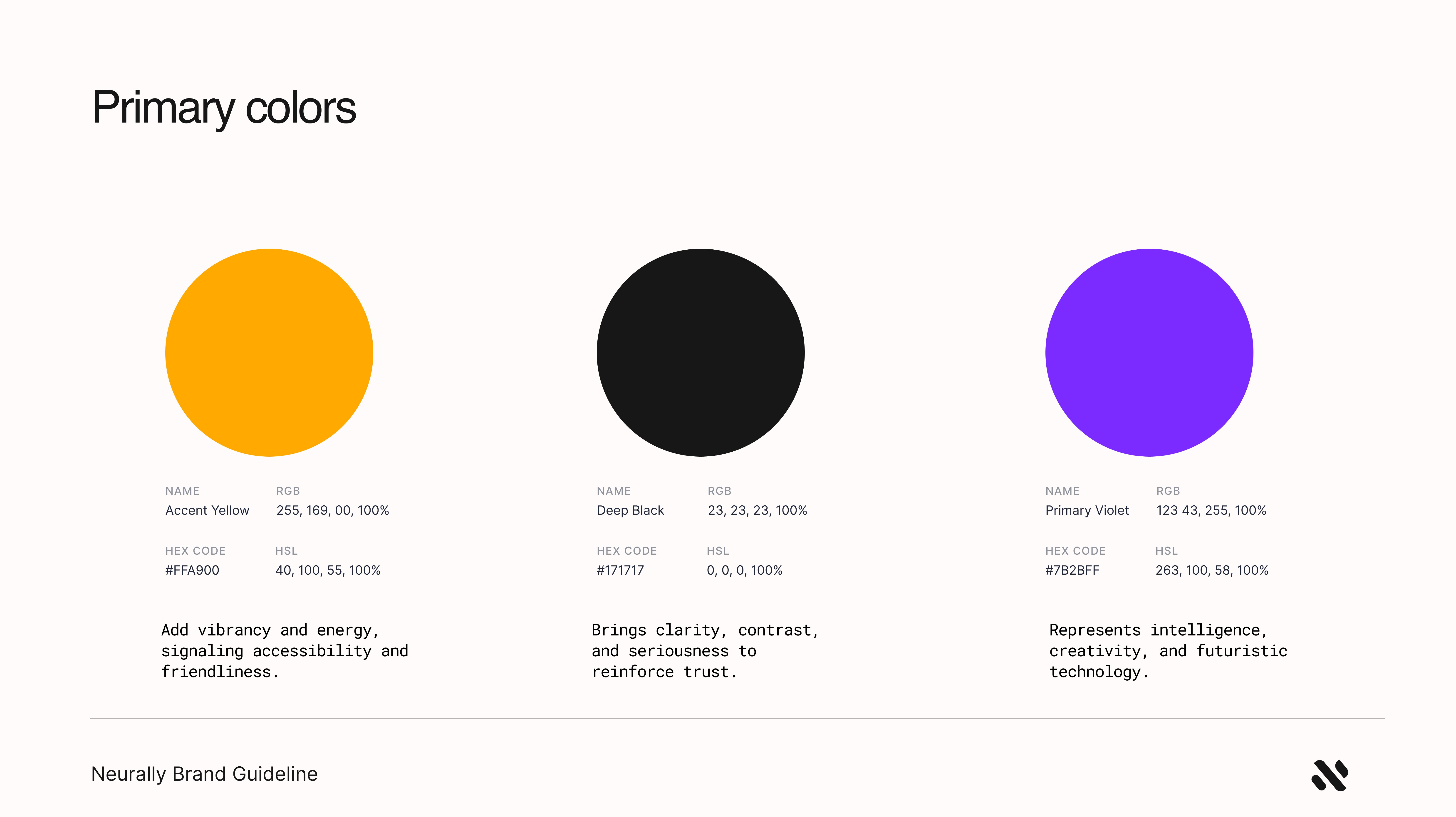
I started with colors. Instead of jumping straight to a palette, I asked myself: What emotions should Neurally evoke? The answer was clarity, trust, and innovation. That’s why I chose:
Primary Violet – Represents intelligence, creativity, and futuristic technology.
Deep Black – Brings clarity, contrast, and seriousness to reinforce trust.
Bright Accent Yellows & Teals – Add vibrancy and energy, signaling accessibility and friendliness.
The palette ensures that the brand feels tech-forward yet approachable, helping it stand out in a crowded SaaS market.
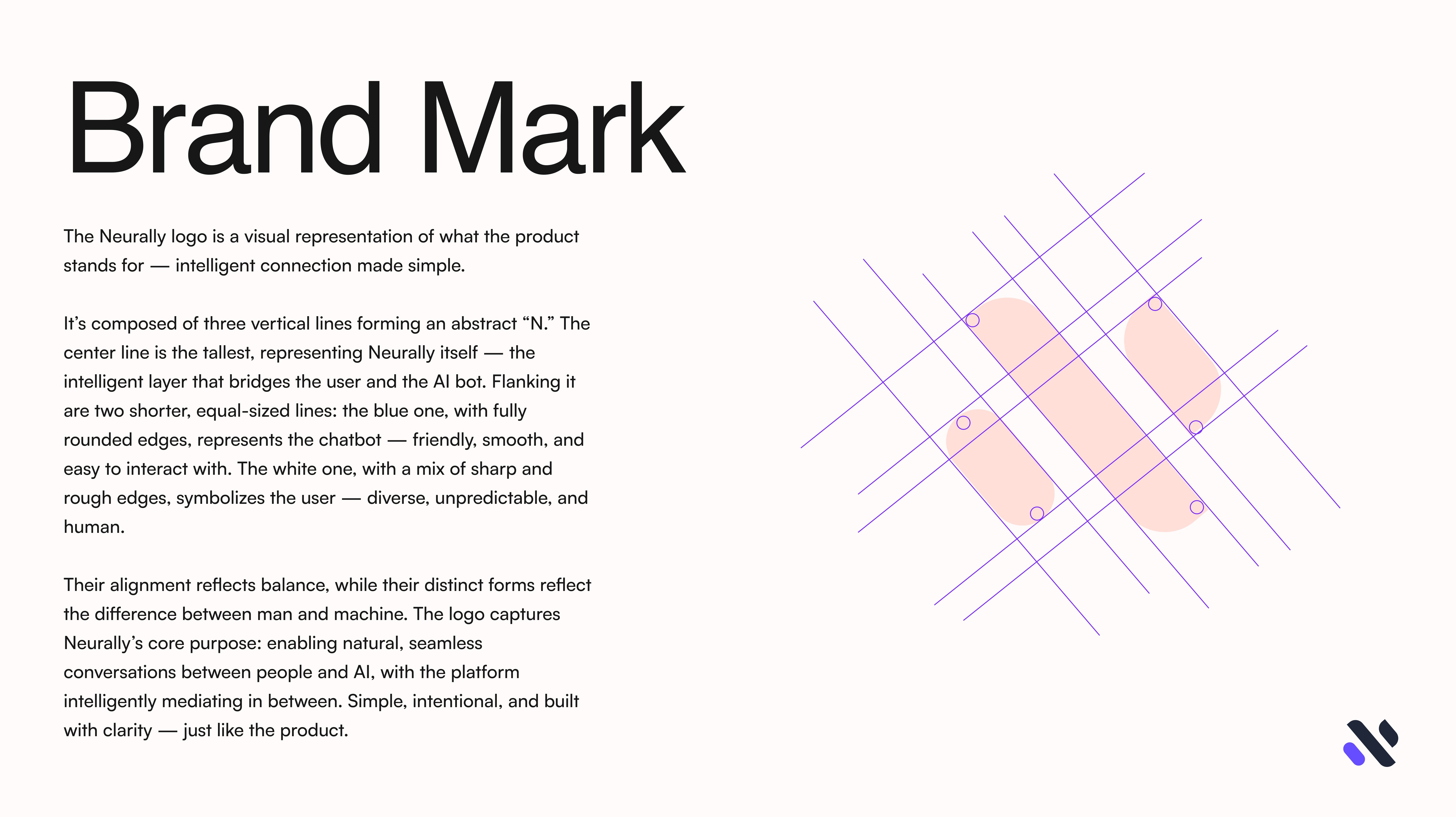
The logo followed naturally. I wanted it to mirror the idea of neural connections — dynamic, flowing, yet structured. The design uses interconnected shapes to symbolize both technology (neural networks) and people (human connection).
Typography
I used Helvetica for clarity and timeless legibility, paired with Satoshi Variable for a modern, flexible edge. Together, they balance professionalism and contemporary tech personality—ensuring the identity speaks equally well to enterprises and startups.
Patterns & Applications
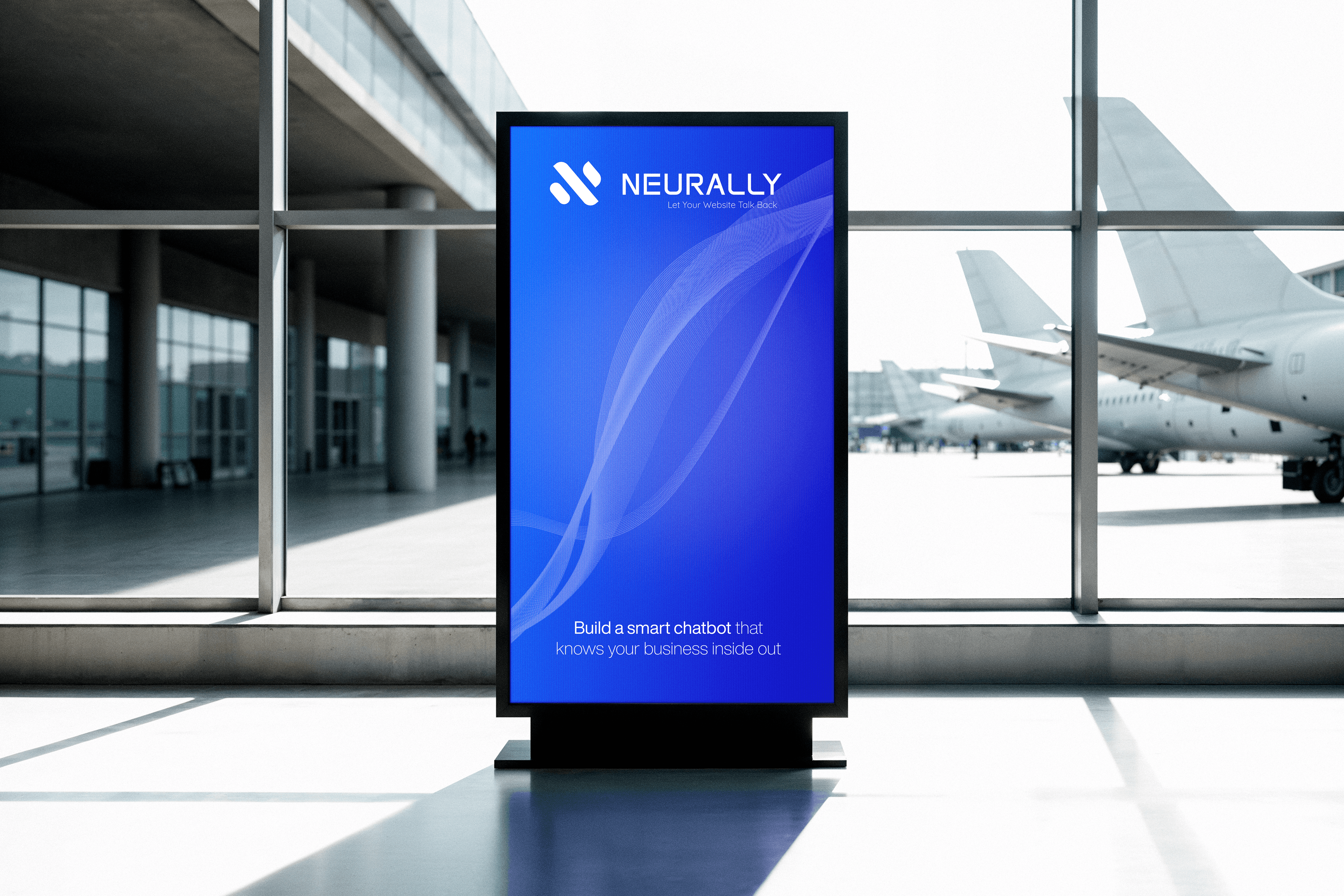
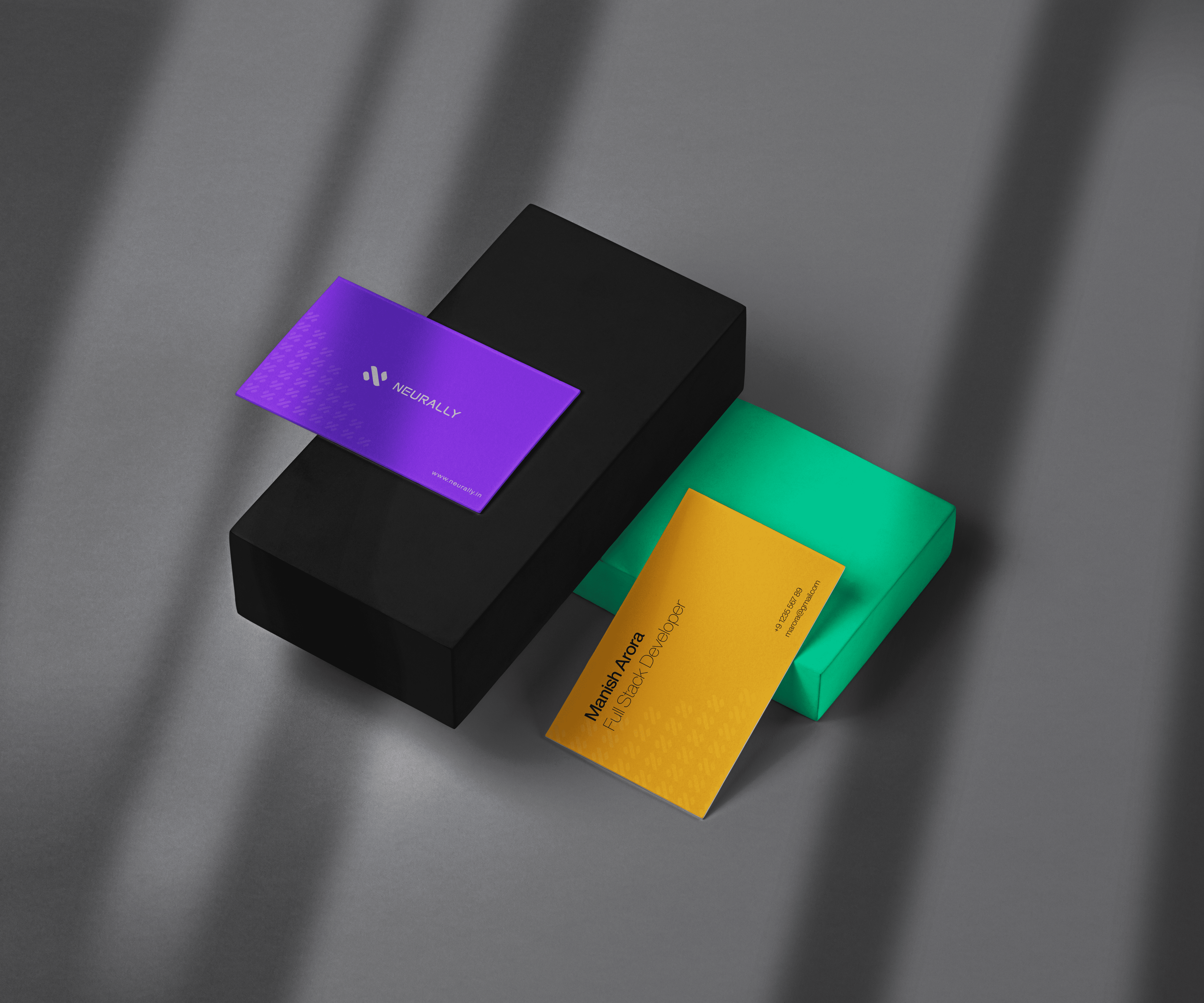
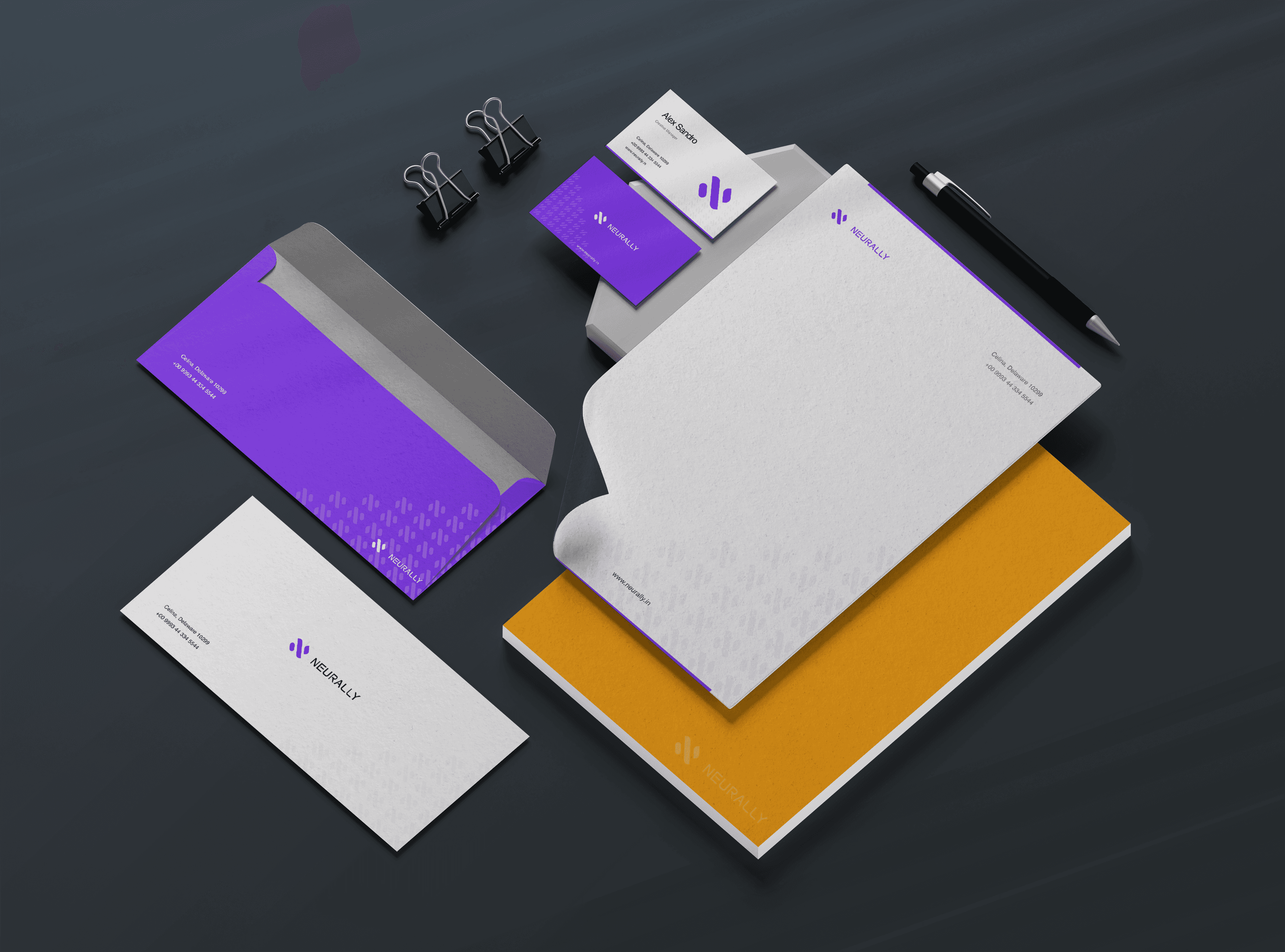
Supporting elements like geometric patterns and gradients were introduced to reflect data flow and adaptability. These were carried across stationery, business cards, website visuals, and dashboard UI, creating a cohesive design ecosystem.
Brand Differentiation
Many chatbot builders look overly “corporate” or overly “playful.” I positioned Neurally right in the sweet spot—futuristic, intelligent, and professional, yet still friendly and human-centered. This balance helps establish trust while making the product accessible to non-technical audiences.
The Web App – Turning Strategy Into Experience
After shaping the brand’s identity, the natural next step was to bring it to life in a tangible product—the web app. The challenge here was different: unlike branding, which was about defining who the brand is, the web app was about how users would experience it every single day.
This phase wasn’t just about screens and layouts—it was about translating strategy into interactions. The goal was to make every tap, scroll, and click feel aligned with the identity we had just crafted.
I started by asking: What should a user feel the moment they interact with Neurally?
The answer was clear — clarity and confidence.
Key Design Priorities
Simplicity in complexity: Chatbot setup is inherently technical (API integrations, training data, flow logic, fallback handling). My role was to abstract away the jargon and present it through clean, guided UI.
Conversational UX: Since Neurally is built around conversation, the interface itself needed to feel conversational — avoiding cold, form-heavy flows.
Scalable structure: Whether a user wanted a basic chatbot or a deeply customized AI system, the app had to scale gracefully without overwhelming them.
My Approach
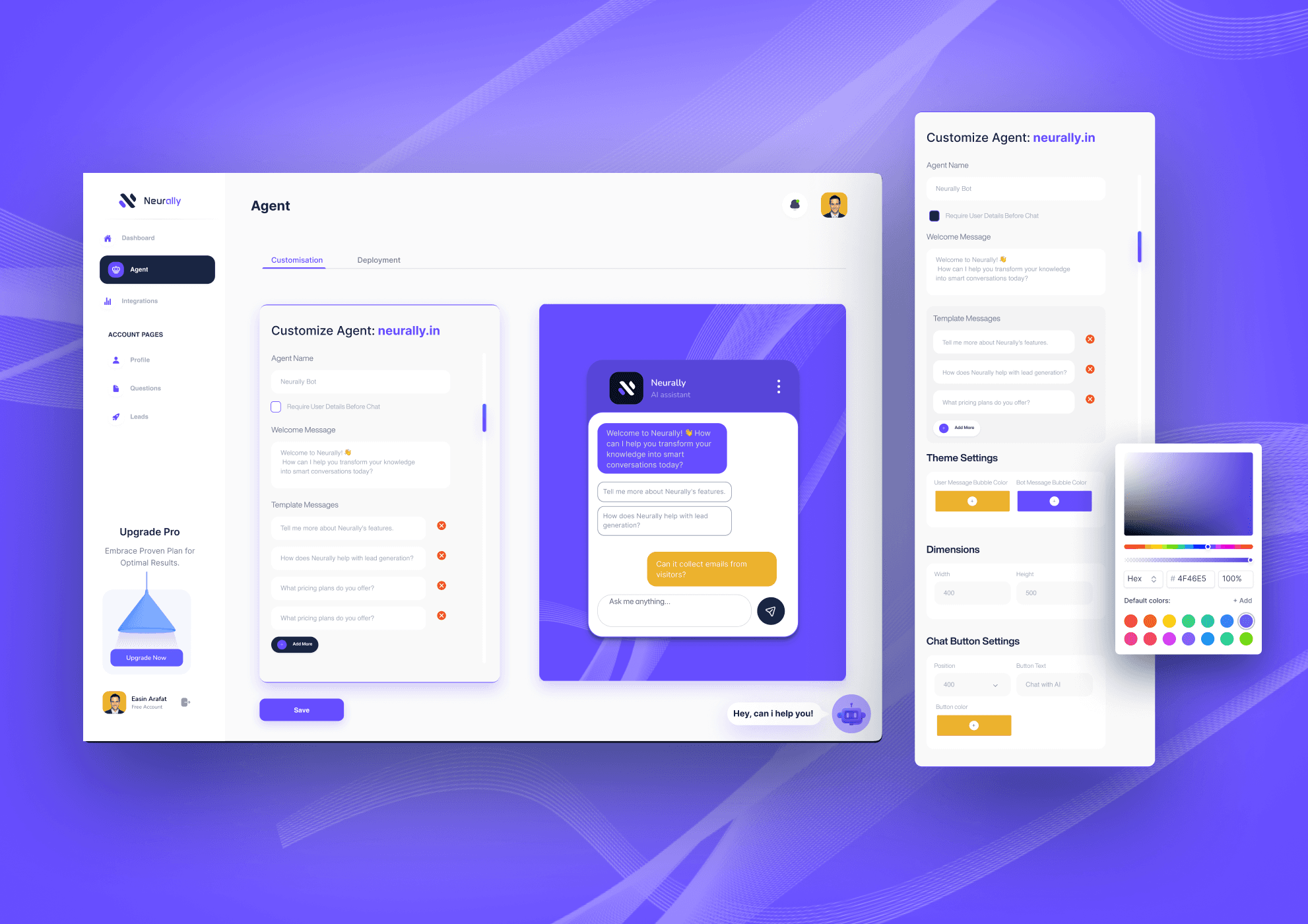
Wireframes → High-Fidelity UI: I began with low-fidelity sketches to experiment with flows like chatbot creation, testing, and deployment. These evolved into high-fidelity wireframes in Figma, where I refined interactions and microcopy.
Guided Onboarding: Complex setups were broken down into progressive steps with tooltips and inline suggestions. Instead of dumping fields on users, I guided them through decisions like choosing an LLM, defining intents, and managing integrations.
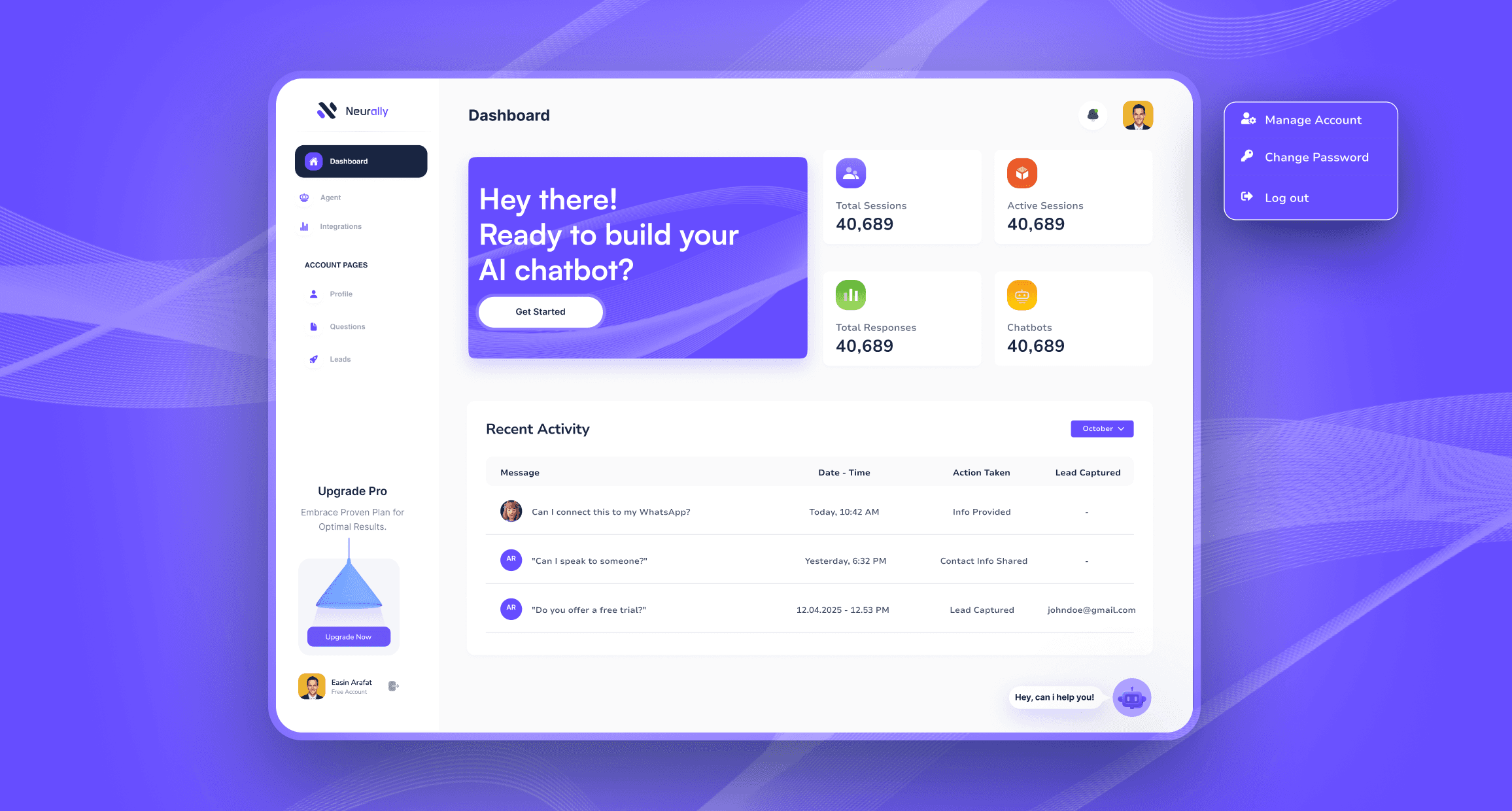
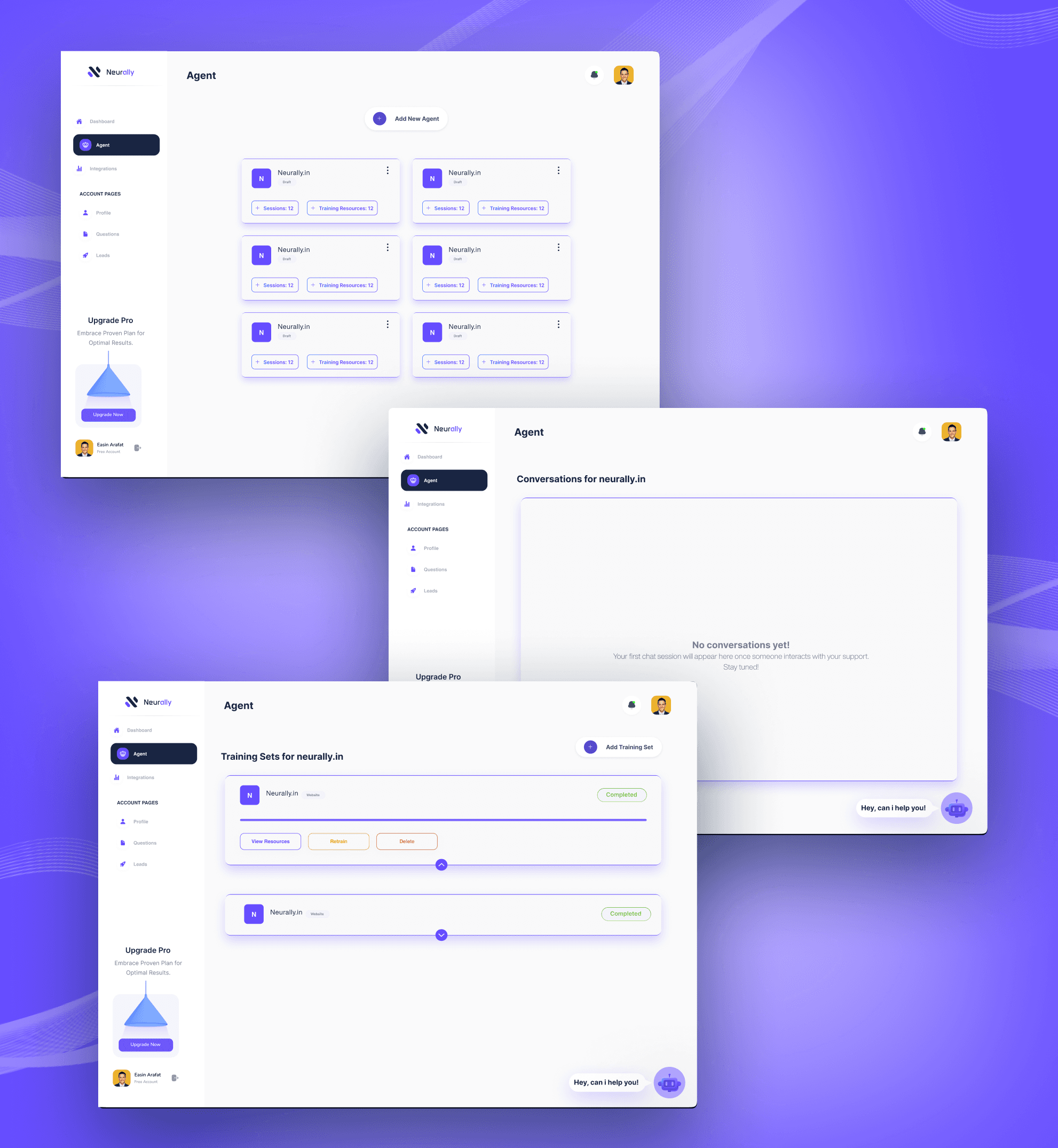
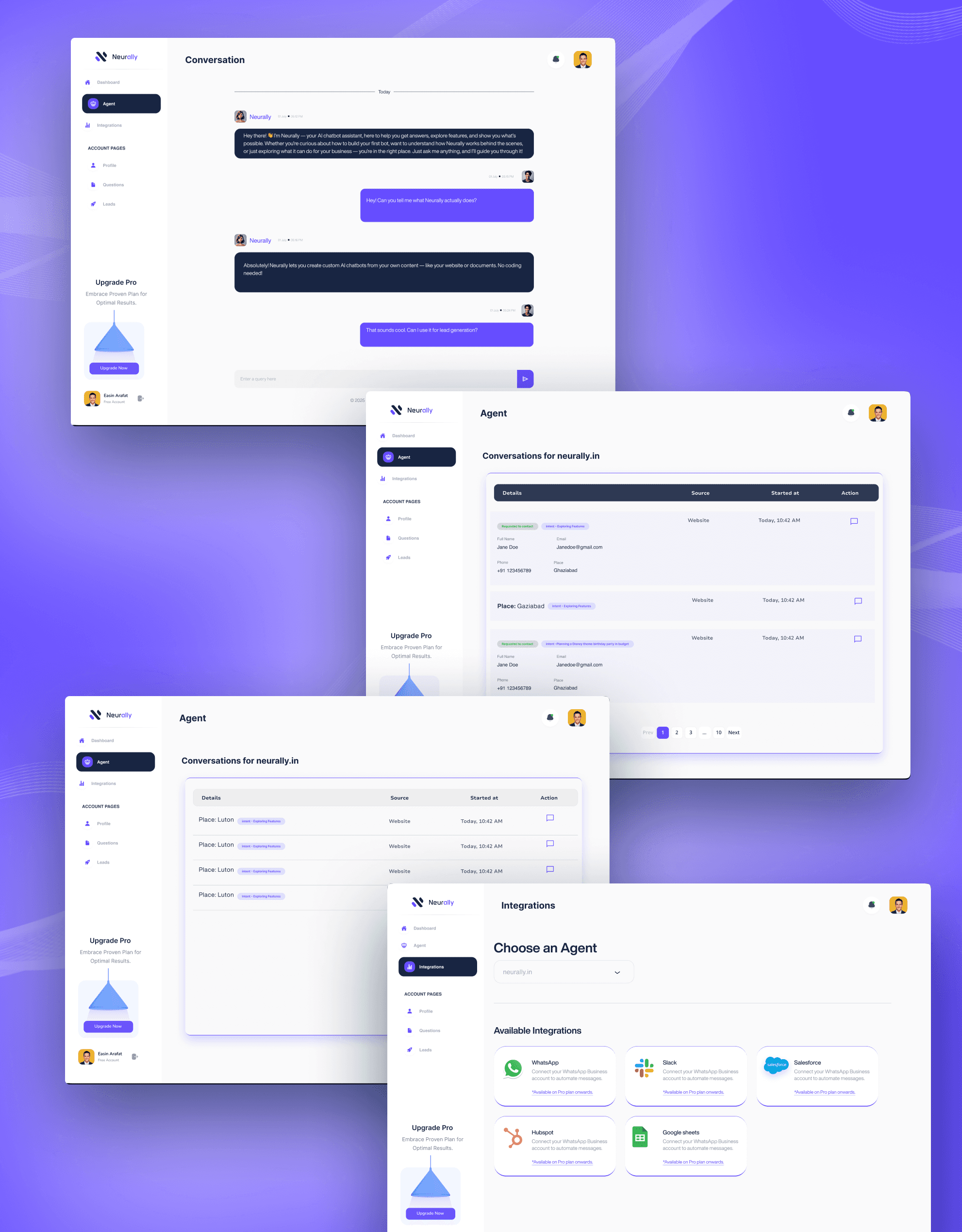
Dashboard & Analytics: I designed a central dashboard where users could monitor conversation metrics, user engagement, and error rates. The focus was on data storytelling — not just showing numbers, but helping users interpret them.
Light Technical Layer: While I’m not a backend developer, I collaborated with engineers to ensure my designs aligned with the architecture (React + Node.js). I also created design tokens and component libraries that made front-end implementation smoother.
Result
The web app became a reflection of Neurally’s brand: technically powerful, but human at its core. By prioritizing usability and visual consistency, I ensured that even the most complex chatbot setups felt intuitive, approachable, and distinctly Neurally.
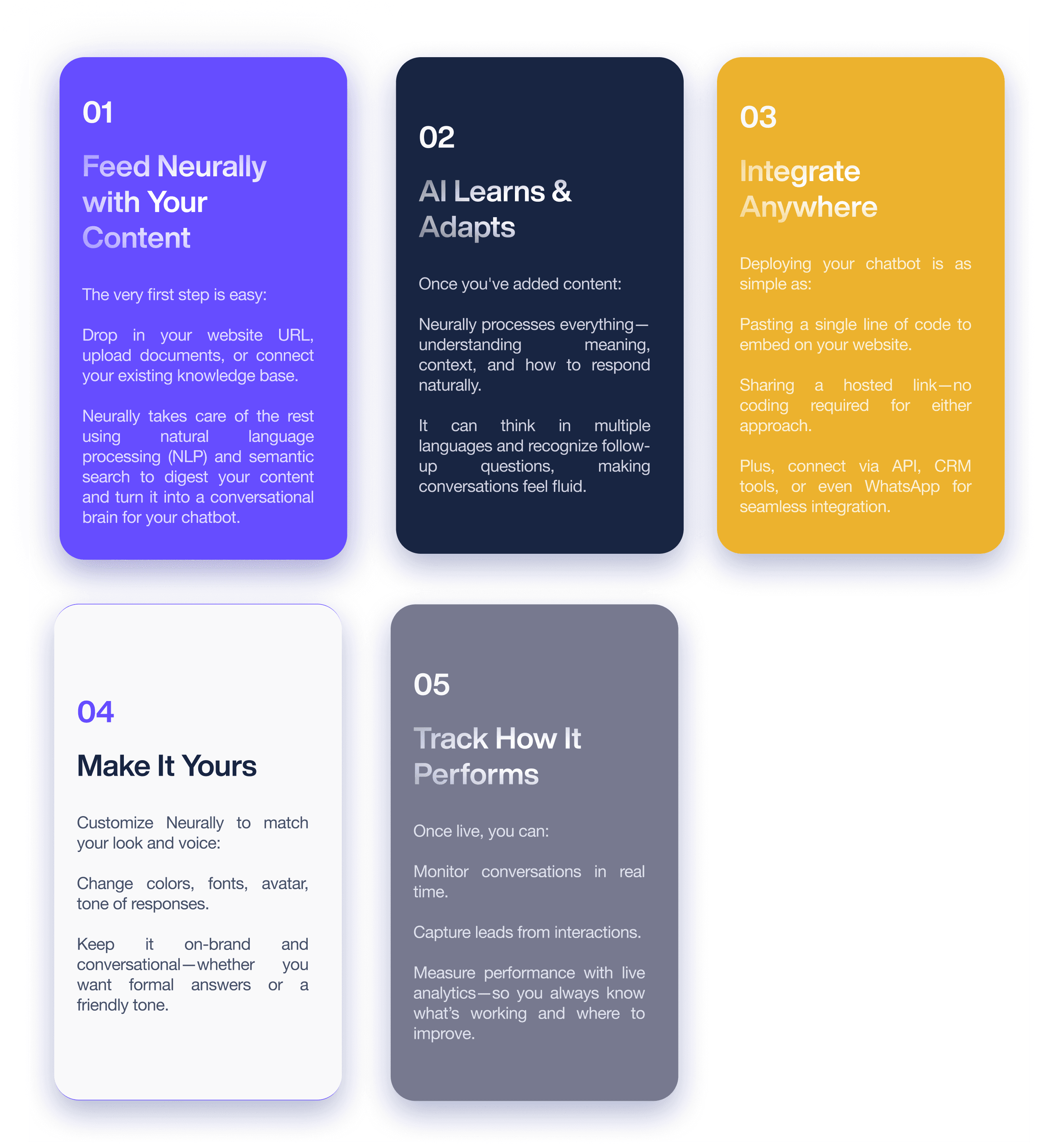
Neurally in Action - From Setup to Smart Chatbot, here is how it works.

Website Design
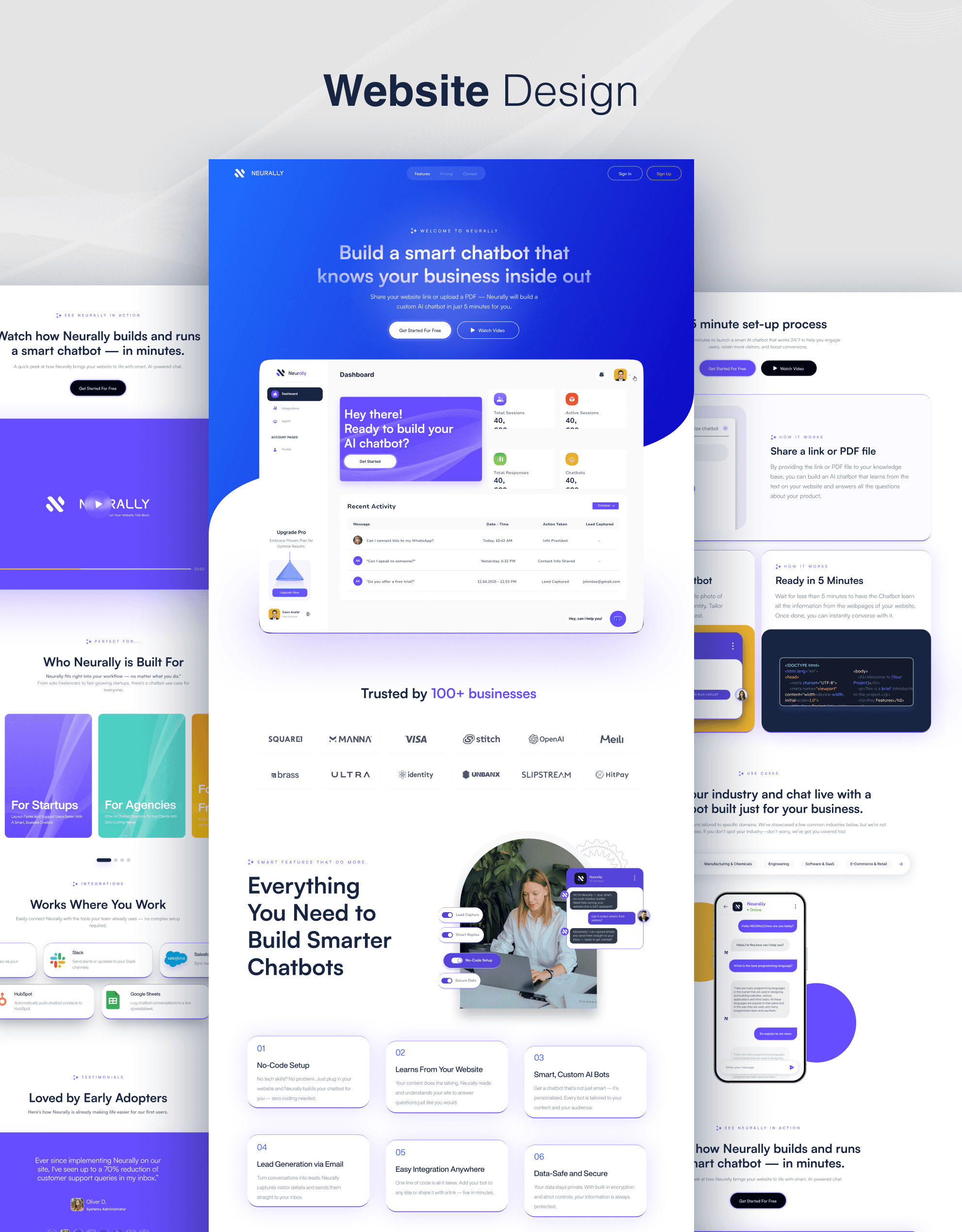
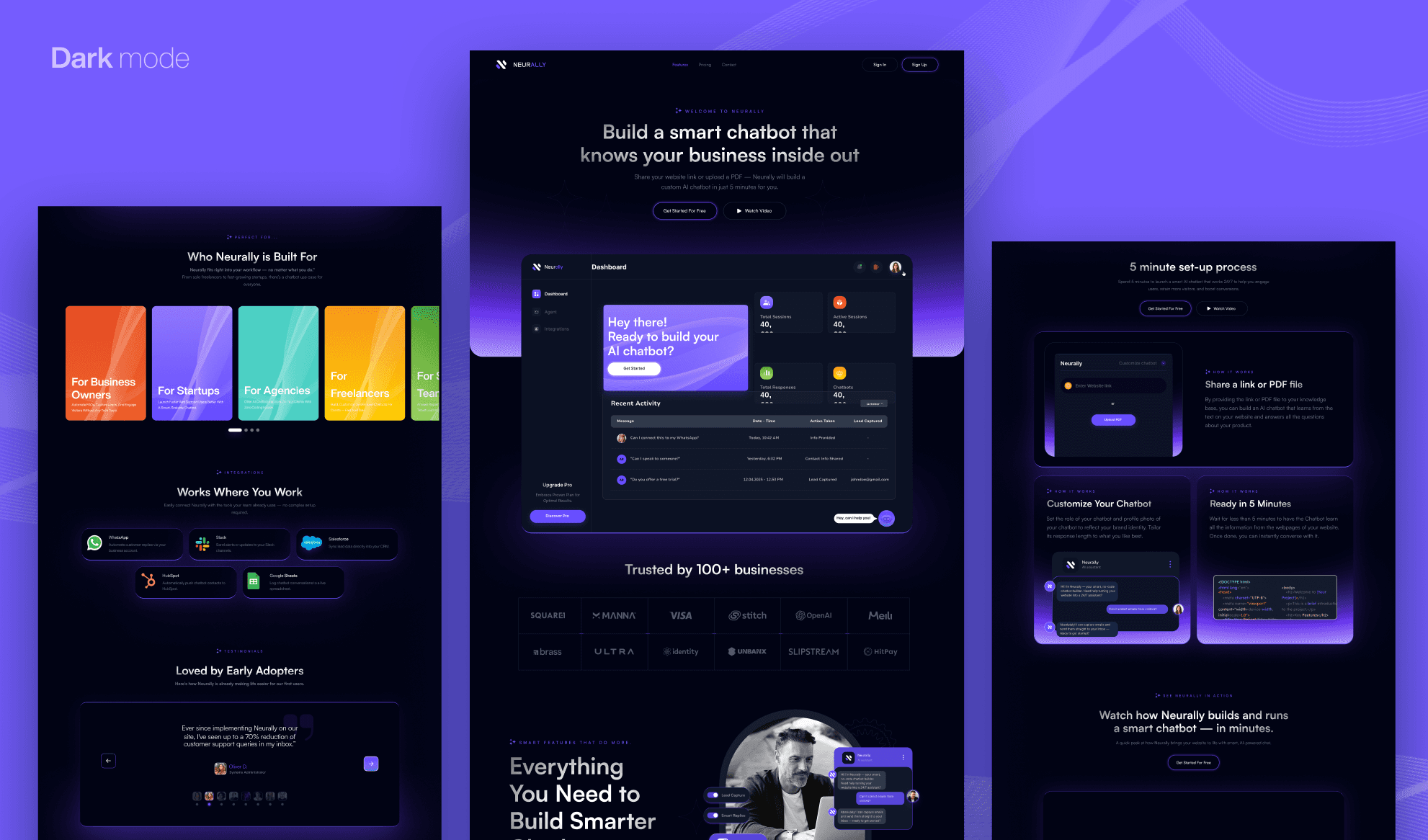
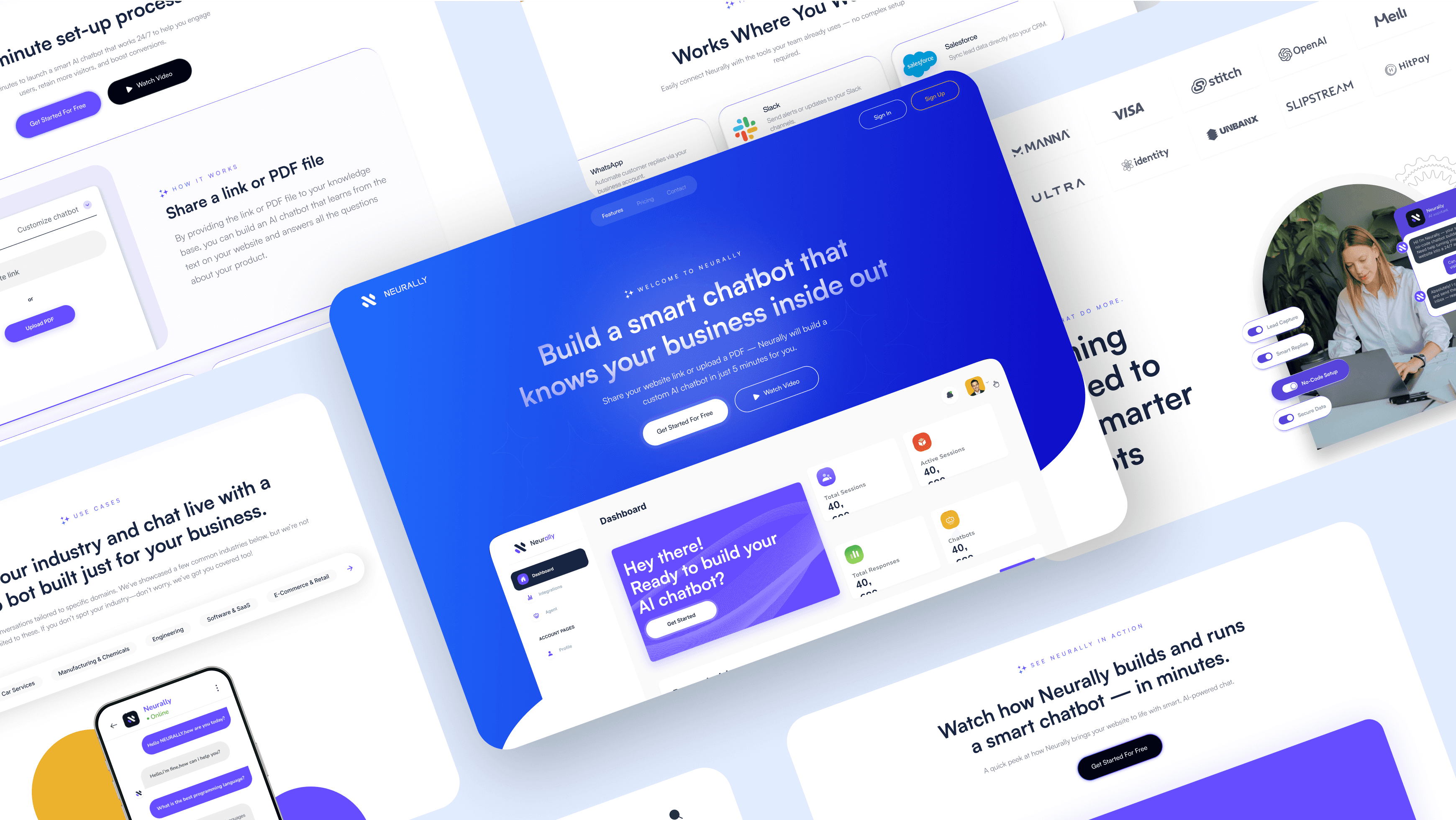
The website served as Neurally’s primary marketing engine — designed not only to introduce the product but also to attract, educate, and convert potential customers.
From a marketing standpoint, the site was optimized to work as a growth tool:
SEO-driven structure ensured visibility by aligning page hierarchy, metadata, and content with high-intent keywords related to AI chatbots and customer automation.
Conversion-focused copywriting translated complex AI capabilities into simple, benefit-oriented language that resonated with business owners and decision-makers.
Strategic CTAs guided visitors through the funnel — from curiosity (“What is Neurally?”) to action (“Book a Demo” / “Get Started”).
From a UX standpoint, the design emphasized simplicity, clarity, and trust:
Information architecture was built for quick comprehension — introducing the product, showcasing its value, and answering objections without overwhelming the user.
Visual hierarchy and consistent branding helped users focus on what mattered most, reducing friction in the browsing journey.
Accessibility best practices (contrast ratios, legible typography, mobile-first design) ensured inclusivity and reach across audiences.
Performance optimization (fast load times, responsive design) supported both user satisfaction and SEO rankings.
The outcome was a website that did more than look good — it acted as a scalable marketing and sales asset. By marrying SEO-friendly content with a user-first design, Neurally built credibility, captured organic traffic, and created a smooth path from awareness to conversion.
Project Summary
A Quick Recap Before You Go
Neurally is an AI-powered chatbot platform built to help businesses deliver instant, human-like conversations with their customers. The platform enables organizations to automate support, capture leads, and provide round-the-clock engagement—without the complexity or rigidity of traditional chat systems.
When I joined the project, Neurally had a solid technical foundation but lacked a cohesive brand identity and user experience. The website explained the product in a functional way but didn’t inspire trust or connect emotionally with its target audience. For businesses, the value was there, but the storytelling, design clarity, and adoption journey needed refinement.
My role was to lead the product and brand design strategy. This included:
Defining Neurally’s brand identity to feel approachable, modern, and trustworthy—positioning it as a credible AI partner.
Designing a clear, conversion-oriented website experience with SEO-friendly content and intuitive flows that reduced friction for first-time users.
Crafting a conversational UX writing style that made interactions with the chatbot feel more natural and less robotic.
Aligning the technical functionality with the user journey, ensuring both businesses and customers could easily adopt and benefit from the platform.
By blending branding, marketing intent, and user experience design, Neurally evolved from a promising AI tool into a market-ready product with personality and purpose. The outcome was not just improved usability but also stronger business impact—greater trust, higher engagement, and a clearer path to customer acquisition and growth.
More Works
(AR — 02)
©2025
NEURALLY
Neurally helps businesses engage customers with intelligent, human-like chat that works across web, apps, and beyond.
Branding
Website
Dashboard
Introduction
Neurally is an AI chatbot platform that converts a company’s existing knowledge-website content, documents, FAQs, and internal databases-into a conversational assistant within minutes and without code.
Neurally - AI That Understands You like you.
Teams embed it with one line of code or share a hosted link, then monitor performance and leads from a dashboard. Security and privacy are emphasized with enterprise-grade controls, while the bot answers using LLM-powered NLP, semantic search, and context awareness.
I led brand identity + logo, the marketing website, and the web app (dashboard + chat experience)—keeping the product’s AI core front and center while making it approachable.
Challange
Building a chatbot sounds simple in theory but in reality, it’s one of the most technically complex and resource-heavy processes a business can take on.
Building chatbots is notoriously complex. Most existing solutions demand a steep learning curve - requiring technical setups, flow-based scripting, and constant manual training. For small businesses, startups, or even mid-sized teams, this becomes overwhelming. The gap was clear: while AI itself is becoming more accessible, the process of creating and deploying an AI chatbot is still intimidatingly technical.
With Neurally, the vision was simple yet ambitious - let anyone build a powerful AI chatbot by just adding a website link, uploading documents, or feeding in basic content. But making “simple” work at scale is never easy.
In short, the challenge was not just about designing a tool - it was about turning a technically dense process into a delightful, no-code product that anyone could use, while giving Neurally a brand identity strong enough to stand out in a crowded market.
Solution & My Role
To tackle the challenges Neurally faced, I approached the project with a design-first mindset, focusing on creating a strong brand identity, intuitive user flows, and an engaging experience that simplifies chatbot creation for non-technical users.
Branding & Identity
When I began crafting the identity for Neurally, I knew the brand needed to feel human yet intelligent — something that resonates with both technology and empathy.
I started with colors. Instead of jumping straight to a palette, I asked myself: What emotions should Neurally evoke? The answer was clarity, trust, and innovation. That’s why I chose:
Primary Violet – Represents intelligence, creativity, and futuristic technology.
Deep Black – Brings clarity, contrast, and seriousness to reinforce trust.
Bright Accent Yellows & Teals – Add vibrancy and energy, signaling accessibility and friendliness.
The palette ensures that the brand feels tech-forward yet approachable, helping it stand out in a crowded SaaS market.
The logo followed naturally. I wanted it to mirror the idea of neural connections — dynamic, flowing, yet structured. The design uses interconnected shapes to symbolize both technology (neural networks) and people (human connection).
Typography
I used Helvetica for clarity and timeless legibility, paired with Satoshi Variable for a modern, flexible edge. Together, they balance professionalism and contemporary tech personality—ensuring the identity speaks equally well to enterprises and startups.
Patterns & Applications
Supporting elements like geometric patterns and gradients were introduced to reflect data flow and adaptability. These were carried across stationery, business cards, website visuals, and dashboard UI, creating a cohesive design ecosystem.
Brand Differentiation
Many chatbot builders look overly “corporate” or overly “playful.” I positioned Neurally right in the sweet spot—futuristic, intelligent, and professional, yet still friendly and human-centered. This balance helps establish trust while making the product accessible to non-technical audiences.
The Web App – Turning Strategy Into Experience
After shaping the brand’s identity, the natural next step was to bring it to life in a tangible product—the web app. The challenge here was different: unlike branding, which was about defining who the brand is, the web app was about how users would experience it every single day.
This phase wasn’t just about screens and layouts—it was about translating strategy into interactions. The goal was to make every tap, scroll, and click feel aligned with the identity we had just crafted.
I started by asking: What should a user feel the moment they interact with Neurally?
The answer was clear — clarity and confidence.
Key Design Priorities
Simplicity in complexity: Chatbot setup is inherently technical (API integrations, training data, flow logic, fallback handling). My role was to abstract away the jargon and present it through clean, guided UI.
Conversational UX: Since Neurally is built around conversation, the interface itself needed to feel conversational — avoiding cold, form-heavy flows.
Scalable structure: Whether a user wanted a basic chatbot or a deeply customized AI system, the app had to scale gracefully without overwhelming them.
My Approach
Wireframes → High-Fidelity UI: I began with low-fidelity sketches to experiment with flows like chatbot creation, testing, and deployment. These evolved into high-fidelity wireframes in Figma, where I refined interactions and microcopy.
Guided Onboarding: Complex setups were broken down into progressive steps with tooltips and inline suggestions. Instead of dumping fields on users, I guided them through decisions like choosing an LLM, defining intents, and managing integrations.
Dashboard & Analytics: I designed a central dashboard where users could monitor conversation metrics, user engagement, and error rates. The focus was on data storytelling — not just showing numbers, but helping users interpret them.
Light Technical Layer: While I’m not a backend developer, I collaborated with engineers to ensure my designs aligned with the architecture (React + Node.js). I also created design tokens and component libraries that made front-end implementation smoother.
Result
The web app became a reflection of Neurally’s brand: technically powerful, but human at its core. By prioritizing usability and visual consistency, I ensured that even the most complex chatbot setups felt intuitive, approachable, and distinctly Neurally.
Neurally in Action - From Setup to Smart Chatbot, here is how it works.
Website Design
The website served as Neurally’s primary marketing engine — designed not only to introduce the product but also to attract, educate, and convert potential customers.
From a marketing standpoint, the site was optimized to work as a growth tool:
SEO-driven structure ensured visibility by aligning page hierarchy, metadata, and content with high-intent keywords related to AI chatbots and customer automation.
Conversion-focused copywriting translated complex AI capabilities into simple, benefit-oriented language that resonated with business owners and decision-makers.
Strategic CTAs guided visitors through the funnel — from curiosity (“What is Neurally?”) to action (“Book a Demo” / “Get Started”).
From a UX standpoint, the design emphasized simplicity, clarity, and trust:
Information architecture was built for quick comprehension — introducing the product, showcasing its value, and answering objections without overwhelming the user.
Visual hierarchy and consistent branding helped users focus on what mattered most, reducing friction in the browsing journey.
Accessibility best practices (contrast ratios, legible typography, mobile-first design) ensured inclusivity and reach across audiences.
Performance optimization (fast load times, responsive design) supported both user satisfaction and SEO rankings.
The outcome was a website that did more than look good — it acted as a scalable marketing and sales asset. By marrying SEO-friendly content with a user-first design, Neurally built credibility, captured organic traffic, and created a smooth path from awareness to conversion.
Project Summary
A Quick Recap Before You Go
Neurally is an AI-powered chatbot platform built to help businesses deliver instant, human-like conversations with their customers. The platform enables organizations to automate support, capture leads, and provide round-the-clock engagement—without the complexity or rigidity of traditional chat systems.
When I joined the project, Neurally had a solid technical foundation but lacked a cohesive brand identity and user experience. The website explained the product in a functional way but didn’t inspire trust or connect emotionally with its target audience. For businesses, the value was there, but the storytelling, design clarity, and adoption journey needed refinement.
My role was to lead the product and brand design strategy. This included:
Defining Neurally’s brand identity to feel approachable, modern, and trustworthy—positioning it as a credible AI partner.
Designing a clear, conversion-oriented website experience with SEO-friendly content and intuitive flows that reduced friction for first-time users.
Crafting a conversational UX writing style that made interactions with the chatbot feel more natural and less robotic.
Aligning the technical functionality with the user journey, ensuring both businesses and customers could easily adopt and benefit from the platform.
By blending branding, marketing intent, and user experience design, Neurally evolved from a promising AI tool into a market-ready product with personality and purpose. The outcome was not just improved usability but also stronger business impact—greater trust, higher engagement, and a clearer path to customer acquisition and growth.
More Works
(AR — 02)
©2025
NEURALLY
Neurally helps businesses engage customers with intelligent, human-like chat that works across web, apps, and beyond.
Branding
Website
Dashboard
Introduction
Neurally is an AI chatbot platform that converts a company’s existing knowledge-website content, documents, FAQs, and internal databases-into a conversational assistant within minutes and without code.
Neurally - AI That Understands You like you.
Teams embed it with one line of code or share a hosted link, then monitor performance and leads from a dashboard. Security and privacy are emphasized with enterprise-grade controls, while the bot answers using LLM-powered NLP, semantic search, and context awareness.
I led brand identity + logo, the marketing website, and the web app (dashboard + chat experience)—keeping the product’s AI core front and center while making it approachable.
Challange
Building a chatbot sounds simple in theory but in reality, it’s one of the most technically complex and resource-heavy processes a business can take on.
Building chatbots is notoriously complex. Most existing solutions demand a steep learning curve - requiring technical setups, flow-based scripting, and constant manual training. For small businesses, startups, or even mid-sized teams, this becomes overwhelming. The gap was clear: while AI itself is becoming more accessible, the process of creating and deploying an AI chatbot is still intimidatingly technical.
With Neurally, the vision was simple yet ambitious - let anyone build a powerful AI chatbot by just adding a website link, uploading documents, or feeding in basic content. But making “simple” work at scale is never easy.
In short, the challenge was not just about designing a tool - it was about turning a technically dense process into a delightful, no-code product that anyone could use, while giving Neurally a brand identity strong enough to stand out in a crowded market.
Solution & My Role
To tackle the challenges Neurally faced, I approached the project with a design-first mindset, focusing on creating a strong brand identity, intuitive user flows, and an engaging experience that simplifies chatbot creation for non-technical users.
Branding & Identity
When I began crafting the identity for Neurally, I knew the brand needed to feel human yet intelligent — something that resonates with both technology and empathy.
I started with colors. Instead of jumping straight to a palette, I asked myself: What emotions should Neurally evoke? The answer was clarity, trust, and innovation. That’s why I chose:
Primary Violet – Represents intelligence, creativity, and futuristic technology.
Deep Black – Brings clarity, contrast, and seriousness to reinforce trust.
Bright Accent Yellows & Teals – Add vibrancy and energy, signaling accessibility and friendliness.
The palette ensures that the brand feels tech-forward yet approachable, helping it stand out in a crowded SaaS market.
The logo followed naturally. I wanted it to mirror the idea of neural connections — dynamic, flowing, yet structured. The design uses interconnected shapes to symbolize both technology (neural networks) and people (human connection).
Typography
I used Helvetica for clarity and timeless legibility, paired with Satoshi Variable for a modern, flexible edge. Together, they balance professionalism and contemporary tech personality—ensuring the identity speaks equally well to enterprises and startups.
Patterns & Applications
Supporting elements like geometric patterns and gradients were introduced to reflect data flow and adaptability. These were carried across stationery, business cards, website visuals, and dashboard UI, creating a cohesive design ecosystem.
Brand Differentiation
Many chatbot builders look overly “corporate” or overly “playful.” I positioned Neurally right in the sweet spot—futuristic, intelligent, and professional, yet still friendly and human-centered. This balance helps establish trust while making the product accessible to non-technical audiences.
The Web App – Turning Strategy Into Experience
After shaping the brand’s identity, the natural next step was to bring it to life in a tangible product—the web app. The challenge here was different: unlike branding, which was about defining who the brand is, the web app was about how users would experience it every single day.
This phase wasn’t just about screens and layouts—it was about translating strategy into interactions. The goal was to make every tap, scroll, and click feel aligned with the identity we had just crafted.
I started by asking: What should a user feel the moment they interact with Neurally?
The answer was clear — clarity and confidence.
Key Design Priorities
Simplicity in complexity: Chatbot setup is inherently technical (API integrations, training data, flow logic, fallback handling). My role was to abstract away the jargon and present it through clean, guided UI.
Conversational UX: Since Neurally is built around conversation, the interface itself needed to feel conversational — avoiding cold, form-heavy flows.
Scalable structure: Whether a user wanted a basic chatbot or a deeply customized AI system, the app had to scale gracefully without overwhelming them.
My Approach
Wireframes → High-Fidelity UI: I began with low-fidelity sketches to experiment with flows like chatbot creation, testing, and deployment. These evolved into high-fidelity wireframes in Figma, where I refined interactions and microcopy.
Guided Onboarding: Complex setups were broken down into progressive steps with tooltips and inline suggestions. Instead of dumping fields on users, I guided them through decisions like choosing an LLM, defining intents, and managing integrations.
Dashboard & Analytics: I designed a central dashboard where users could monitor conversation metrics, user engagement, and error rates. The focus was on data storytelling — not just showing numbers, but helping users interpret them.
Light Technical Layer: While I’m not a backend developer, I collaborated with engineers to ensure my designs aligned with the architecture (React + Node.js). I also created design tokens and component libraries that made front-end implementation smoother.
Result
The web app became a reflection of Neurally’s brand: technically powerful, but human at its core. By prioritizing usability and visual consistency, I ensured that even the most complex chatbot setups felt intuitive, approachable, and distinctly Neurally.
Neurally in Action - From Setup to Smart Chatbot, here is how it works.
Website Design
The website served as Neurally’s primary marketing engine — designed not only to introduce the product but also to attract, educate, and convert potential customers.
From a marketing standpoint, the site was optimized to work as a growth tool:
SEO-driven structure ensured visibility by aligning page hierarchy, metadata, and content with high-intent keywords related to AI chatbots and customer automation.
Conversion-focused copywriting translated complex AI capabilities into simple, benefit-oriented language that resonated with business owners and decision-makers.
Strategic CTAs guided visitors through the funnel — from curiosity (“What is Neurally?”) to action (“Book a Demo” / “Get Started”).
From a UX standpoint, the design emphasized simplicity, clarity, and trust:
Information architecture was built for quick comprehension — introducing the product, showcasing its value, and answering objections without overwhelming the user.
Visual hierarchy and consistent branding helped users focus on what mattered most, reducing friction in the browsing journey.
Accessibility best practices (contrast ratios, legible typography, mobile-first design) ensured inclusivity and reach across audiences.
Performance optimization (fast load times, responsive design) supported both user satisfaction and SEO rankings.
The outcome was a website that did more than look good — it acted as a scalable marketing and sales asset. By marrying SEO-friendly content with a user-first design, Neurally built credibility, captured organic traffic, and created a smooth path from awareness to conversion.
Project Summary
A Quick Recap Before You Go
Neurally is an AI-powered chatbot platform built to help businesses deliver instant, human-like conversations with their customers. The platform enables organizations to automate support, capture leads, and provide round-the-clock engagement—without the complexity or rigidity of traditional chat systems.
When I joined the project, Neurally had a solid technical foundation but lacked a cohesive brand identity and user experience. The website explained the product in a functional way but didn’t inspire trust or connect emotionally with its target audience. For businesses, the value was there, but the storytelling, design clarity, and adoption journey needed refinement.
My role was to lead the product and brand design strategy. This included:
Defining Neurally’s brand identity to feel approachable, modern, and trustworthy—positioning it as a credible AI partner.
Designing a clear, conversion-oriented website experience with SEO-friendly content and intuitive flows that reduced friction for first-time users.
Crafting a conversational UX writing style that made interactions with the chatbot feel more natural and less robotic.
Aligning the technical functionality with the user journey, ensuring both businesses and customers could easily adopt and benefit from the platform.
By blending branding, marketing intent, and user experience design, Neurally evolved from a promising AI tool into a market-ready product with personality and purpose. The outcome was not just improved usability but also stronger business impact—greater trust, higher engagement, and a clearer path to customer acquisition and growth.
More Works
©2025